How long does Invisalign take? It depends on your teeth, and nobody can honestly name your number before looking at them. Invisalign's own site says treatment can be completed in as little as 6 months. It adds that treatment times vary with the product, wear time and case complexity. This post explains what pushes a case toward the short end or the long end, so you know what to ask at your exam.
How long does Invisalign take, and why is there no single answer?
A tooth moves because steady pressure makes the bone on one side give way while new bone builds on the other. That rebuilding is slow work, and no tray can hurry it. So the length of treatment comes from simple arithmetic: how many trays your teeth need, multiplied by how long each tray stays in.
The American Association of Orthodontists (AAO) says clear aligners are custom-formed to fit your mouth and sequentially apply the pressure required to move the teeth. It also says the number of aligners and the treatment time vary from person to person. Invisalign says you typically switch to a new set weekly or biweekly, depending on your provider's instructions.
A tooth that has only drifted a little needs a few small steps. A tooth that has to travel across the arch needs many. The plan is built from the scan, and the scan is where the count of trays comes from.
What makes some teeth move more slowly than others?
Distance is only half of it. The kind of movement matters just as much, because a tray is a thin shell that pushes on the crown, the part you can see.
Some movements give the shell a lot to work with. Tipping a front tooth a little, or closing a small gap, is a simpler push for a tray. Others are harder.
Turning a round tooth
A canine is rounded, so a tray has less surface to grip when the tooth needs to rotate. Small tooth-colored bumps called attachments can give the tray an edge to push against.
Moving the root
The tray holds the crown, but the root sits in the bone. Shifting the whole tooth, root and all, generally takes longer than tilting it.
Lifting a tooth
Pulling a tooth farther out of the gum, called extrusion, is hard for a tray to do. That one has a measurement behind it.
A 2009 study of 37 patients and 401 front teeth compared planned tooth positions with the positions the teeth reached. It was published in the American Journal of Orthodontics and Dentofacial Orthopedics.
Teeth reached 41% of the planned movement on average. The most accurate movement was lingual constriction, at 47.1%, and the least accurate was extrusion, at 29.6%. Turning the canines was also significantly less accurate than turning most other teeth.
The study is from 2009, so it describes the aligners of that period. It still shows the pattern: a plan is a prediction, and some movements fall further short of it than others.
Age plays a part too. The AAO says adult teeth are more firmly set in the jaw than a younger person's, so moving them takes more time and pressure.
How much do the hours you wear the trays change the timeline?
Teeth move only while a tray is pressing on them. Invisalign says you must wear the trays 20 to 22 hours a day to get the desired results. You take them out to eat, drink anything but water, and brush.
Each tray is made for the position the one before it was supposed to produce. If a tooth falls behind because the trays spent hours in a case, the next tray sits loosely over it. The step does not happen, and you stay in the same tray longer or wait for the plan to catch up. This is the part of the timeline you control, and it is why the hours matter more than the calendar.
What happens if my teeth don't finish where the plan said?
Because a plan is a prediction, some cases need an added set of trays at the end. The teeth are usually scanned again, and a new short series aims for the same finish from where your teeth actually are. Ask whether your estimate includes that possibility, and what it adds to the time.
This is also why treatment has check-in visits. The Invisalign page on our site describes them as short visits to make sure movement is tracking to the plan. A tooth that has fallen a little behind is easier to catch at a check-in than months later.
Is treatment finished when the last tray is done?
Not quite. Invisalign says wearing a retainer after treatment is essential to preventing relapse. Teeth shift naturally from chewing and grinding, and without a retainer they can drift back toward where they began. The AAO says retainers help maintain the results of orthodontic treatment. It adds that you will likely be advised to wear one for an extended period.
What does the first visit tell you about your timeline?
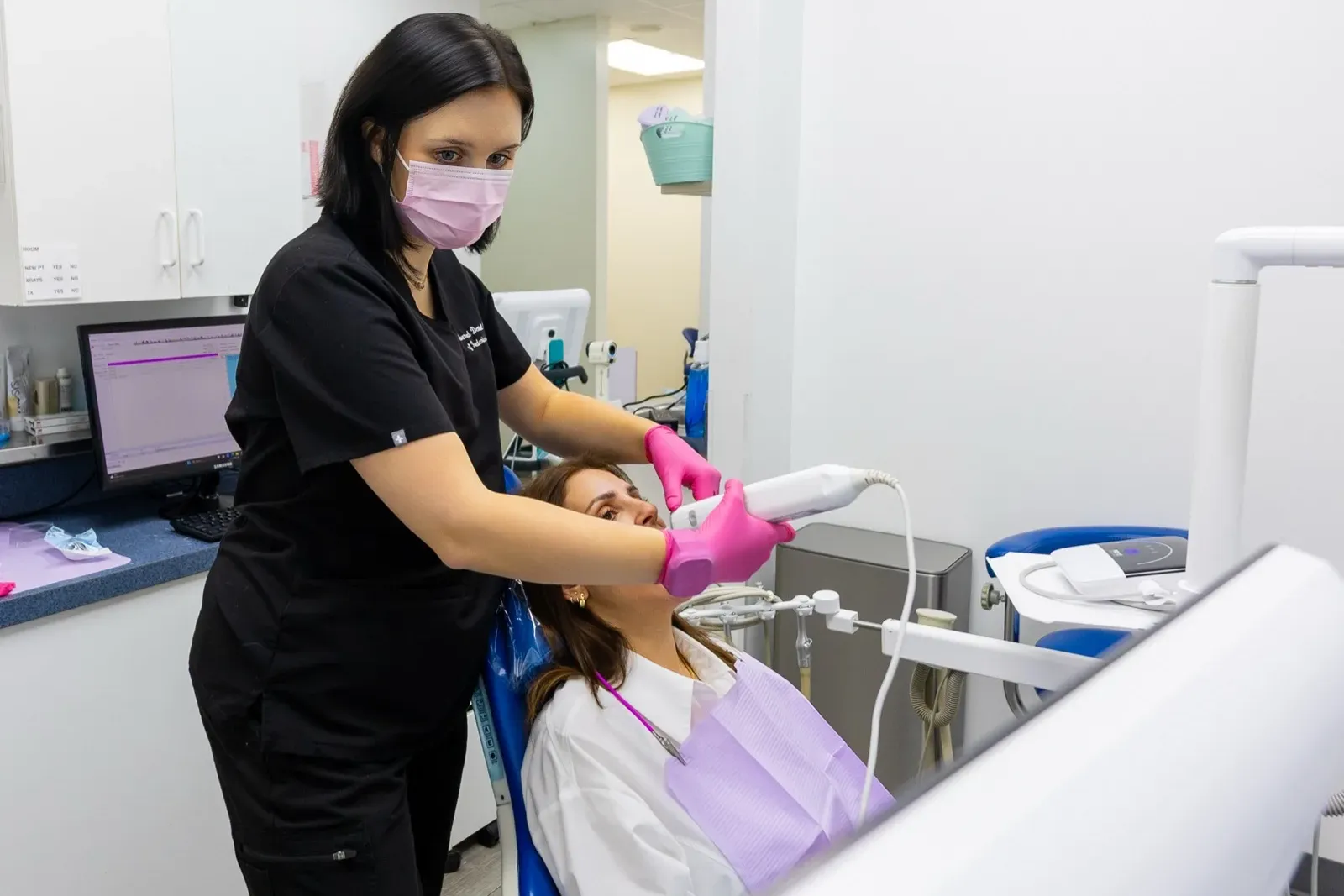
At our office, the first visit includes an exam by the doctor, photos or a digital scan, X-rays and a conversation. The scanner takes a 3D image of your teeth and replaces the trays of impression material. That image is what a timeline is built from, because the exam shows how far each tooth has to move.
Dr. Waris is an Invisalign-trained provider. If the exam finds a case too complex for aligners, we refer it out for complex orthodontic care.
Before you decide, ask how many trays the plan uses, what wear time it assumes, and whether the estimate includes added trays and the retainer. Our Invisalign page lays out the steps from scan to retainer, and Invisalign sits alongside our other cosmetic dentistry options. To ask about your own case or to check how your plan handles coverage, call (540) 891-9911 or reach us through our contact page.