Porcelain Veneers in Fredericksburg, VA
A veneer is a thin shell bonded to the front of a tooth to change how it looks while the tooth stays yours.
or call (540) 891-9911
Two Kinds of Veneer: Porcelain and Composite
Composite veneers use tooth-colored resin that we shape directly on your tooth, often in a single visit and typically for less cost up front. Resin is softer than porcelain and absorbs pigment from coffee and tea more easily, so it tends to stain and wear sooner.
Porcelain is a glazed ceramic. Its glassy surface does not absorb stain, and it is hard enough to keep its shape for years. Each shell is made outside your mouth, so placement happens at a later visit. We walk you through both options and tell you which one fits your goals and your budget.
Who It’s For: Stained, Chipped, Uneven or Gapped Teeth
Veneers often suit people whose teeth are…
- stained more deeply than whitening can lift
- chipped or worn at the edges
- slightly misaligned or uneven in shape
- gapped, and you would rather close the spaces than move the teeth with aligners
Heavy grinding at night puts repeated force on thin porcelain, which can chip or crack it. Decay under a veneer keeps spreading out of sight, and gum disease can loosen the tooth the veneer sits on, so both need treatment first. Your exam shows which of these applies to you.
If crowding or the way your teeth meet is what bothers you, Invisalign may be the better first step. Aligners move the teeth themselves, while a veneer only changes the surface in front of them. Dr. Waris is Invisalign-trained, so you can ask which route fits your teeth.
What to Expect, from Conversation to Placement
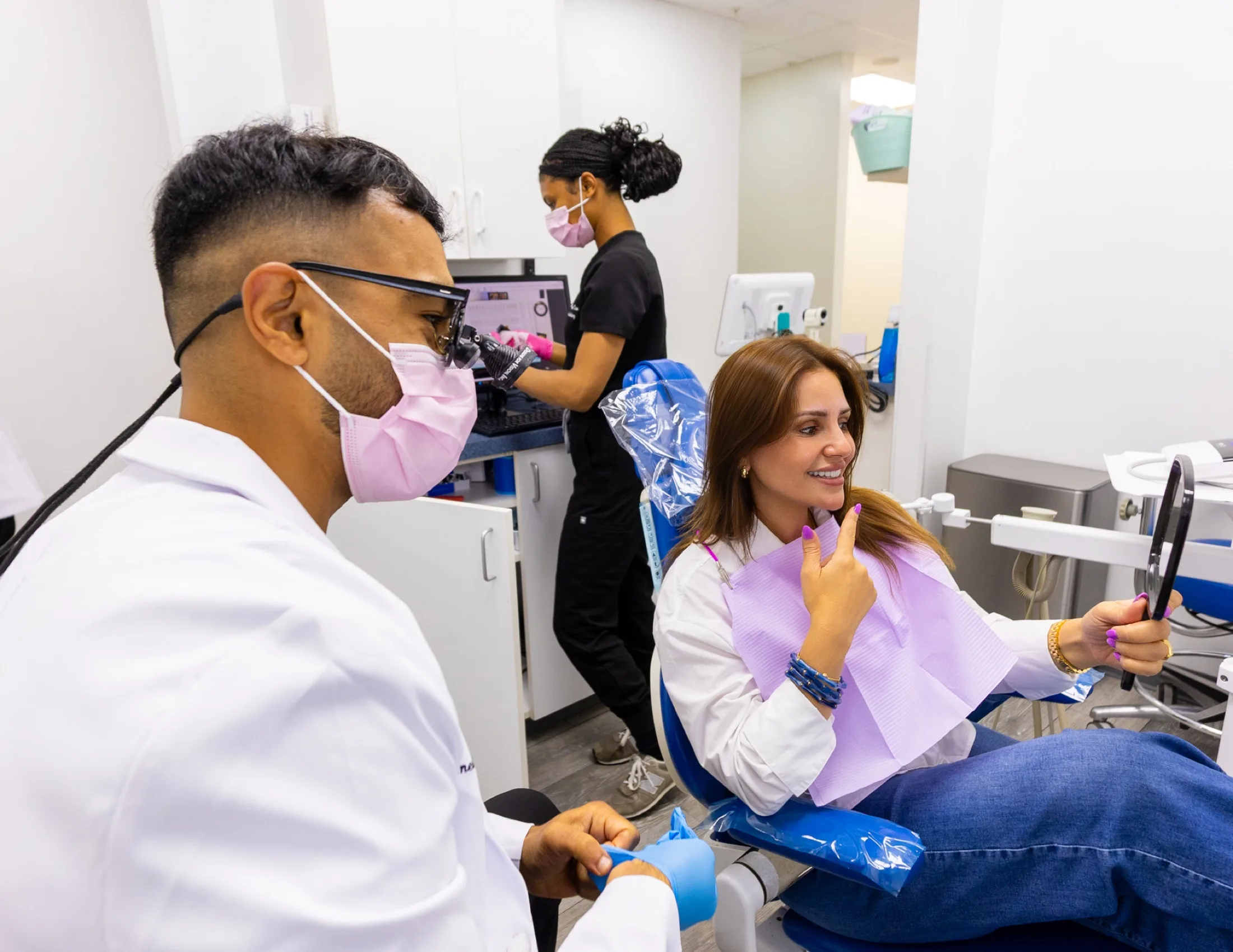
- Consultation. A doctor examines your teeth and listens to what you want changed. Photos and a digital scan record your current shape and shade, so the veneers can be designed around your own teeth.
- A preview of the plan. Before we touch a tooth, we go over the planned shape, length, and shade with you. Changes are easiest to make now, because nothing has been removed yet.
- Preparation. The doctor removes a thin layer of enamel from the front of each tooth, so the veneer can sit flush instead of looking bulky. Enamel does not grow back, which is why the plan comes first. Temporary coverings protect the teeth while your veneers are made.
- Placement. Each veneer is tried on first, so we can judge its fit and color beside your neighboring teeth. Once you both approve, we bond it to the tooth with dental adhesive and harden the adhesive with a curing light.
- Settling in. Your tongue notices even a small change in tooth shape, so new veneers can feel bigger than they are for a few days. If a spot still feels high when you bite, tell us and we can adjust it.

Starting With What You Want to Change
We start with what you want to change, then look for the option that removes the least enamel. Whitening and composite remove little or none, so we tell you when one of them gets you most of the way. Sometimes Invisalign should come first.
A first visit here includes a full exam by the doctor, photos or a digital scan, X-rays, and a sit-down conversation. The X-rays matter for veneers, because they show decay between teeth and under old fillings that a veneer would otherwise cover. If the preparation step makes you nervous, the office offers extra-gentle numbing, nitrous oxide, and oral sedation.
- Composite option available
Cost and Coverage for Veneers
Veneer cost depends on how many teeth you treat and whether you choose porcelain or composite. It also depends on how much design and lab work your smile needs. Those details come out of your exam, so we talk through cost with you at your consultation.
Many insurance plans treat veneers as cosmetic and do not pay for them. Work that treats a damaged tooth, such as a crown, may be covered in part. We are in-network with many PPO plans and accept Medicaid, so call (540) 891-9911 to ask what yours covers.
Ways to pay: CareCredit, Cherry, Sunbit, LendingPoint, and our in-house payment plans.
Ask about your coverageVeneer Questions
They can, if every tooth is made the same flat white or the shapes ignore your face. Natural teeth vary in shade and are slightly translucent at the edges. We plan the color and outline of each veneer around your own teeth and smile.
Porcelain is hard and keeps its color, so how long a veneer lasts depends mostly on what happens around it. Decay can start at the edge where the veneer meets your tooth, grinding can chip porcelain, and gums that recede can expose the edge. Brushing, flossing, and regular checkups protect that edge. Composite typically needs replacing sooner.
We numb the area first. Numbing blocks the pain signal from the tooth, so during preparation you typically feel pressure and vibration rather than pain. Enamel has no nerve, but the layer beneath it senses hot and cold, so your teeth may be sensitive for a few days afterward.
Yes. A veneer covers only the front surface. The back and sides of the tooth, and the line where veneer meets tooth, still collect plaque, and the acid in plaque softens enamel. Brushing, flossing, and checkups matter as much as before, because decay at that edge is hard to spot yourself.
Yes. Composite is built up on the tooth in the chair, often in one visit, and typically costs less. Porcelain is made outside the mouth, which takes longer, and its glazed surface resists stain and wear better. At your consultation we go through how each one fits your goals.
Related care: Teeth Whitening, Smile Makeover & Bonding, Cosmetic Dentistry, Nervous About the Dentist?.